Regions Republic of Ireland
Planting Investments in Fertile Soil
As both businessman and philanthropist, Atlantic Founder Chuck Feeney was a value investor, seeking to create maximum bang for the buck. He sought investment opportunities especially in underappreciated or undervalued places. When visiting his ancestral home of Ireland in the mid-to-late 1980s to scout properties, he became acutely aware of the recession’s toll on the country. In the face of high unemployment and few prospects for work, university graduates were leaving for other countries, creating a brain drain that could be potentially devastating to Ireland’s future.
Feeney sensed that well-placed philanthropic investments could help invigorate the country. “Chuck is an entrepreneur. He saw a people whose skill sets and opportunities for impact were underdeveloped,” said Christopher G. Oechsli, Atlantic president and CEO.
Atlantic began making grants in 1987 and kept at it for three decades. Hallmarks of the foundation’s work have included stimulating a knowledge economy by revitalizing higher education, transforming the design and delivery of services for children and older adults, and protecting and expanding human and civil rights for those marginalized in Irish society. The key to Atlantic’s impact was establishing strong working relationships with and among government and nongovernmental organization partners.
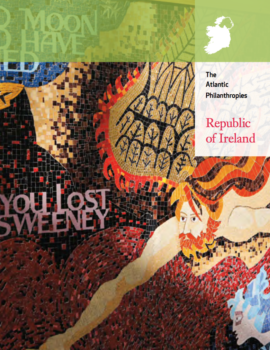
The Atlantic Philanthropies in the Republic of Ireland
This book tells the story of Atlantic’s and our grantees’ impact and work in the Republic of Ireland.
From 1987-2016, we invested $1.3b in the Republic of Ireland to advance higher education, human rights and services for the young and old.
51% of 25-34 yr olds graduated university in 2013 vs 29% in 2000
1st National Strategy for Dementia in Ireland
2015 Marriage Equality Referendum voted in with massive approval
More About Our Work in Ireland
Explore results, research, and stories by clicking below
-
University Research Across Ireland
Atlantic catalysed co-investment with government to support higher education and advanced research in the Republic of Ireland.
-
Prevention & Early Intervention
Heading off problems before they take root in children’s lives can help young people grow and flourish.
-
Dementia
We've helped people with dementia get needed care while living at home, connected to family and community. The Global Brain Health Institute supports efforts to improve the practice of dementia care.
-
Immigration & Migration
We've supported groups advocating for reform and working to build opportunity, provide hope and promote dignity for millions.
-
LGBT
Atlantic provided crucial support to organizations in the Republic of Ireland and South Africa working to secure access to rights and services for LGBT people.
-
Advancing Children’s Rights
Children have rights to education, health, adequate standard of living, protection from abuse and neglect, and equality and non-discrimination.
-
Age-Friendly Communities & Policies
Atlantic advocated for adoption of age-friendly policies and practices that recognize older individuals as people who still have much to contribute to society.
-
Disability
Our work on behalf of people with disabilities has focused on designing customized programs and services that meet the needs of each individual.


